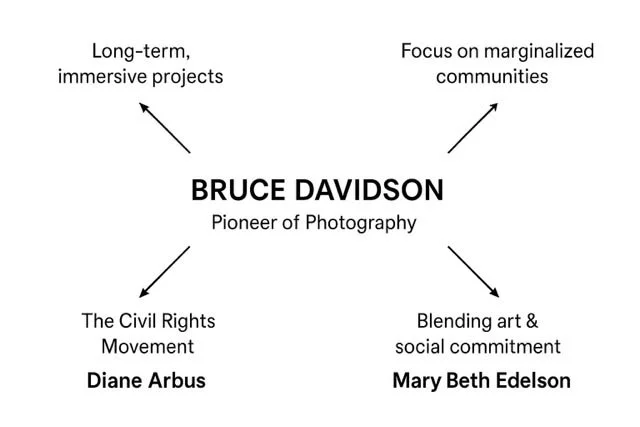
Bruce Davidson is regarded as a pioneer of photography because he pushed documentary photography beyond traditional photojournalism, blending humanistic empathy with long-term immersion projects that revealed marginalized lives and social realities in America. His work combined artistry with activism, making him one of the most influential voices in mid-20th century photography.
⸻
Why Davidson is considered a pioneer
1. Long-term, immersive projects
• Unlike many photographers of his era, Davidson spent months or even years embedded in communities.
• Example: Brooklyn Gang (1959), where he documented teenagers with intimacy and without judgment.
• This deep engagement foreshadowed later documentary approaches that valued sustained presence over quick reportage.
⸻
2. Focus on marginalized communities
• East 100th Street (1970) captured life in a Harlem block over two years, photographing with dignity and collaboration.
• He gave visibility to people often excluded from mainstream narratives.
• His method anticipated today’s participatory and ethical documentary practices.
⸻
3. The Civil Rights Movement
• His series Time of Change (1961–65) provided some of the most powerful photographic records of the struggle for racial equality.
• He didn’t just cover events; he built trust with activists and communities, giving the movement a personal, human face.
⸻
4. Blending art and social commitment
• Davidson balanced aesthetic refinement with social responsibility.
• His images were not only documents but also works of art — carefully composed, yet deeply empathetic.
• This fusion influenced how photography could function both in galleries and in political contexts.
⸻
5. Influence on later generations
• Inspired photographers like Nan Goldin, Mary Ellen Mark, and more contemporary social documentarians who adopted his immersive, long-term approach.
• His work demonstrated that photography could be activist, personal, and beautiful all at once.
⸻
👉 In short: Bruce Davidson pioneered a deeply engaged, humanistic form of documentary photography that combined intimacy, artistry, and social awareness — setting a model for later generations of socially concerned photographers.