Chris Killip is regarded as a pioneer of photography because he created some of the most powerful, uncompromising documentary images of working-class Britain in the late 20th century. His work redefined how social realities could be represented and influenced a whole generation of photographers. Here’s why:
⸻
1. Unflinching Documentation of Britain’s Industrial Decline
• In the 1970s and 1980s, Killip photographed the lives of people in the North of England as traditional industries—coal, shipbuilding, steel—collapsed.
• His book In Flagrante (1988) became a landmark, showing the human cost of economic and social upheaval under Thatcherism.
⸻
2. Empathy and Respect for His Subjects
• Unlike outsiders who treated working-class communities as curiosities, Killip lived among the people he photographed, building trust.
• His images show dignity and resilience, even amid hardship, which gave voice to communities rarely represented in mainstream media.
⸻
3. Innovative Documentary Style
• He worked in stark black-and-white, using a large-format 4x5 camera in the field—something unusual for social documentary photography at the time.
• This gave his images a formal, almost monumental presence, elevating everyday lives to the level of history.
⸻
4. Influence on British Documentary Photography
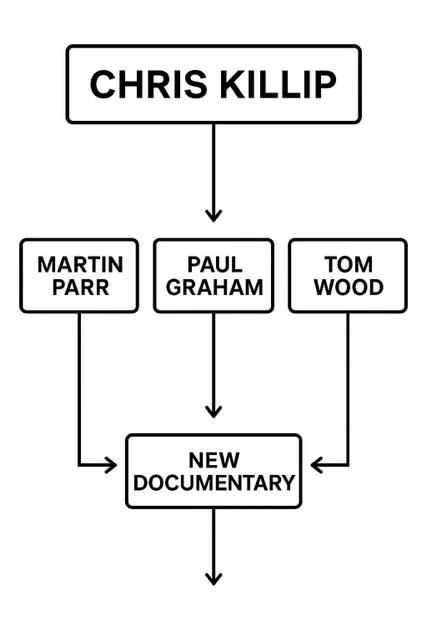
• Killip, along with contemporaries like Martin Parr, Paul Graham, and Tom Wood, pushed British documentary photography beyond reportage into something more personal, critical, and artistic.
• He helped shape the “new documentary” movement in the UK.
⸻
5. Role as a Teacher and Mentor
• Later, as a professor at Harvard, he influenced a new generation of photographers, carrying forward his philosophy of engaged, socially aware photography.
⸻
📷 In short: Chris Killip is a pioneer because he gave working-class Britain an enduring voice in photography, blending empathy with formal innovation. His work stands as a historical record but also as art that redefined documentary practice.