Fay Godwin (1931–2005) is widely regarded as a pioneering photographer because she transformed the way landscape and documentary photography were understood in Britain. Her work was groundbreaking in several ways:
1. Reimagining British Landscape Photography
• Before Godwin, British landscape photography was often romanticized—pastoral, idyllic, and focused on beauty. Godwin shifted the lens toward a more truthful, critical, and sometimes stark vision of the land.
• Her images captured the marks of human presence—fences, pylons, eroded paths, private property signs—making visible the tensions between people, politics, and the environment.
2. Environmental and Political Consciousness
• She linked landscape photography with environmental activism, using her camera to highlight issues of land ownership, access, and conservation.
• Her seminal book Our Forbidden Land (1990) documented the privatization and loss of public access to the countryside. It was both art and manifesto, sparking debate and influencing environmental thought in Britain.
3. Fusion of Documentary and Art
• Godwin blurred the line between documentary realism and fine art photography. Her landscapes were visually striking but also socially engaged, giving them a dual role as aesthetic objects and political statements.
• This made her one of the first British photographers to show that landscape work could be activist, not just decorative.
4. Championing British Identity Through Place
• By photographing across remote parts of Britain—Scotland, Wales, and rural England—she explored national identity through geography, history, and myth.
• Her books with poets like Ted Hughes (Remains of Elmet, 1979) deepened this connection, combining photography with literature in innovative ways.
5. Role as a Trailblazer for Women in Photography
• Working in a field dominated by men, Godwin became one of Britain’s most respected photographers, influencing a generation that followed her.
• Her prominence in the 1970s–1990s opened doors for women in documentary and landscape photography.
In short, Fay Godwin is regarded as a pioneer because she changed what landscape photography could be—turning it into a medium for social commentary, environmental critique, and cultural storytelling, while also paving the way for women in the field.
Fay Godwin vs. Contemporaries in British Photography
1. Don McCullin (b. 1935)
• Known primarily for war photography and gritty urban documentary work in London.
• In later years, McCullin also turned to landscapes, but his approach was often dark and brooding, reflecting his inner turmoil.
• Difference: McCullin’s landscapes are often metaphorical expressions of trauma, while Godwin’s are politically sharp, grounded in land rights, ownership, and access. She positioned the landscape as a public battleground, not just a personal canvas.
2. Paul Hill (b. 1941)
• Central to the growth of British fine art photography in the 1970s–80s, co-founding The Photographers’ Place (a residential workshop in Derbyshire) and teaching extensively.
• His landscapes leaned toward personal vision and experimentation.
• Difference: Hill pushed photography toward art and teaching; Godwin pushed it toward social and environmental activism. Both helped professionalize British photography, but in different spheres.
3. Chris Killip (1946–2020)
• Famous for documenting working-class communities in northern England (In Flagrante).
• His work was deeply social, showing economic decline and resilience.
• Difference: Killip focused on people within industrial landscapes; Godwin focused on the landscape itself as a social subject. They shared a commitment to honesty and the political edge of documentary work.
4. John Davies (b. 1949)
• His large-format black-and-white photographs showed Britain’s industrial and post-industrial landscape in sweeping, formal compositions.
• Difference: Davies mapped the structures of power and industry on the land; Godwin highlighted barriers to access and environmental loss. Together, they reframed how Britain saw its changing terrain.
5. Later Influences (1990s onward)
• Photographers like Jem Southam, Paul Graham, and more recently, Ingrid Pollard, build on Godwin’s legacy—looking critically at how land, class, race, and history intersect.
• Pollard, for example, adds the layer of colonial history and exclusion, something Godwin’s work opened the door to by foregrounding who owns and controls land.
⸻
🌍 Why She Stands Out
• Many contemporaries explored people, class, or war.
• Fay Godwin uniquely combined landscape + politics + activism, turning something once seen as “romantic” into a sharp cultural critique.
• This is why she remains such an important reference point: she broadened what landscape photography meant in Britain.
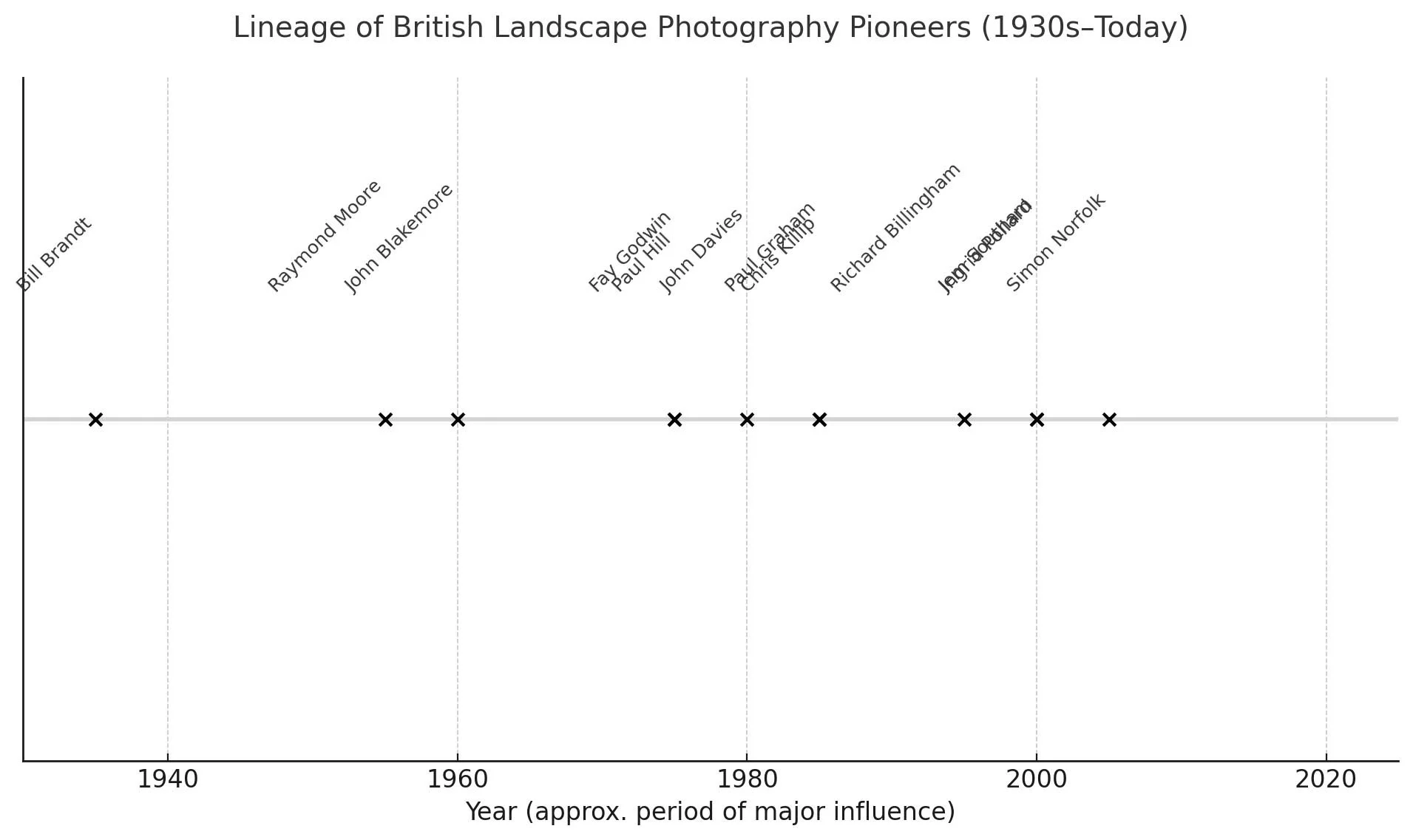
Lineage of British Landscape Photography
1930s–40s: Early Modern Documentary Landscape
• Bill Brandt (1904–1983)
• Photographed Britain’s social classes and later landscapes, often surreal and moody.
• His literary landscapes (influenced by modernism and surrealism) set a tone of ambiguity rather than pure beauty.
• Contribution: Showed that landscape could carry atmosphere, mystery, and psychological depth.
1950s–60s: Documentary Humanism & Emerging Landscape Consciousness
• John Blakemore (b. 1936)
• Explored poetic and intimate landscapes, especially in black and white.
• Contribution: Brought a lyrical, almost spiritual quality to landscape.
• Raymond Moore (1920–1987)
• Quiet, surreal, often overlooked.
• Contribution: First to frame the everyday British environment (back gardens, suburban streets) as worthy of serious landscape photography.
1970s–80s: Landscape as Social and Political Terrain
• Fay Godwin (1931–2005)
• Made landscape explicitly political: land ownership, access rights, environmental damage.
• Worked with poets (Ted Hughes, Philip Larkin) to blend literature and image.
• Contribution: Turned landscape photography into a public and activist form of documentary.
• Paul Hill (b. 1941)
• Brought an educational and artistic infrastructure for British landscape photography (teaching, workshops, critical writing).
• John Davies (b. 1949)
• Used large-format photography to show sweeping industrial/post-industrial landscapes.
• Contribution: Connected landscape to economic structures and urban change.
1990s: Critical Landscape
• Chris Killip (1946–2020) (though earlier, his influence carried on)
• Merged people and land in post-industrial decline (In Flagrante).
• Paul Graham (b. 1956)
• Colour documentary photographer. His series A1: The Great North Road (1983) traced Britain’s social geography via a road trip.
• Contribution: Injected colour and social realism into British landscape/documentary photography.
• Richard Billingham (b. 1970)
• More about family life (Ray’s a Laugh), but his landscapes (esp. later) show working-class environments as part of identity.
2000s–Today: Expanded Landscape (Identity, Race, Ecology)
• Jem Southam (b. 1950)
• Long-term, poetic studies of rivers, coasts, and changing ecologies.
• Contribution: Slow, meditative, environmentally engaged practice.
• Ingrid Pollard (b. 1953)
• Explores race, identity, and exclusion in the British landscape (e.g. how Black Britons are absent in traditional depictions of countryside).
• Contribution: Extended Godwin’s questions of who owns the land to who belongs in the land.
• Simon Norfolk (b. 1963)
• Known for “battlefield landscapes” across the world, blending war and geography.
• Contemporary voices like Vanley Burke (urban landscapes with community), Tish Murtha (working-class environments), and newer eco-focused artists all show Godwin’s influence in making landscape political.
⸻
🌍 Where Fay Godwin Fits
• She stands at the turning point (1970s–80s) where British landscape photography went from romantic/poetic (Brandt, Blakemore, Moore) to critical/activist (Godwin, Davies, Graham).
• Her legacy is felt strongly today, especially in environmentally conscious work and in critical studies of land, power, and belonging.
Here’s the timeline chart — showing how Fay Godwin sits right at the pivot in the 1970s–80s, when British landscape photography shifted from the poetic/modernist tradition into a more political and activist mode.