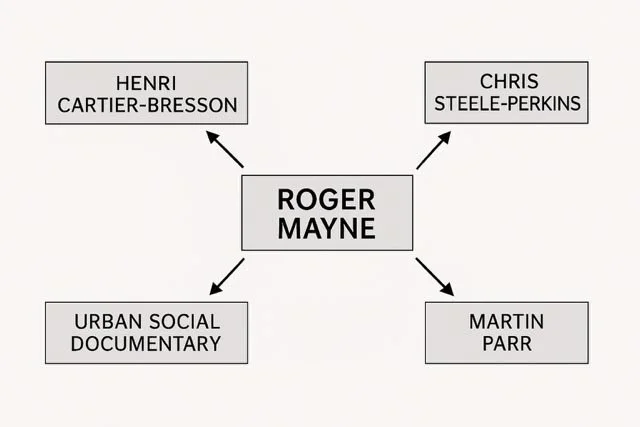
Roger Mayne (1929–2014) made a major contribution to British photography by bringing a fresh, humanistic, and distinctly modern approach to post-war documentary work—especially through his celebrated photographs of London’s Southam Street in the 1950s and early 1960s. His images captured the energy of working-class street life at a moment of social change, combining empathy with a lively, contemporary visual style.
⸻
1. Defining a Post-War British Documentary Aesthetic
• At a time when much British photography was either photojournalistic or formally posed, Mayne embraced spontaneity, photographing people—especially children—engaged in everyday street activities.
• His work reflected optimism, resilience, and community spirit in the face of urban poverty.
⸻
2. Southam Street as a Cultural Record
• Between 1956 and 1961, Mayne returned repeatedly to Southam Street in North Kensington, producing a body of work that became a definitive record of working-class life in London before slum clearance and redevelopment.
• The photographs preserve details of street play, fashion, and community that have since disappeared.
⸻
3. Bridging Art and Documentary
• Mayne’s compositions show clear influences from modernist photography and European street photography (such as Henri Cartier-Bresson), but with a British social documentary sensibility.
• His work was exhibited in art galleries, helping bring street photography into the British art mainstream.
⸻
4. Focus on Youth Culture
• By concentrating on children and teenagers, Mayne documented the emerging youth identity of the post-war period—foreshadowing the cultural shifts of the 1960s.
• His subjects often appear confident, stylish, and self-aware, offering a counter-narrative to stereotypes of working-class deprivation.
⸻
5. Influence on Later British Photographers
• Mayne’s approach inspired later generations of UK street and documentary photographers, including those working in the 1970s and 1980s like Chris Steele-Perkins and Martin Parr, who combined social observation with an eye for character and scene.
⸻
In short, Roger Mayne’s contribution lies in how he married street-level intimacy with artistic composition, creating a warm yet unsentimental record of a vanished London and influencing the course of British social documentary photography.