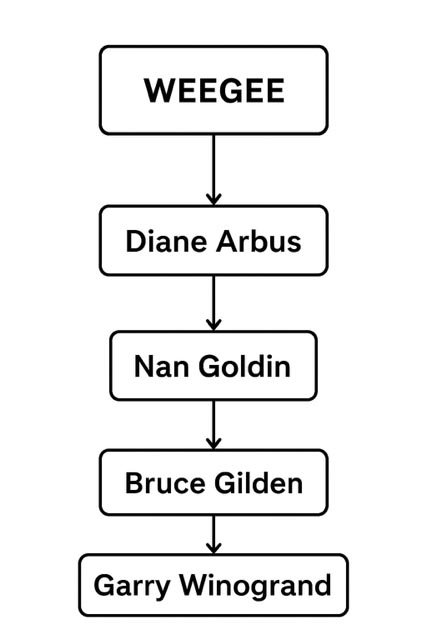
Weegee (born Arthur Fellig) is regarded as a pioneer of photography because he transformed crime and street photography into a gritty, immediate, and highly influential form of visual storytelling. His work in 1930s–40s New York not only captured the raw realities of urban life but also changed the way news and documentary images were made and seen. Here’s why he stands out as a pioneer:
⸻
1. Breaking News Photography
• Weegee earned his nickname (“from Ouija”) because he seemed to have a sixth sense for arriving at crime scenes before the police.
• Using a police radio in his car, he was often first on the scene, creating stark, close-up images of murders, accidents, and fires.
• His direct, unflinching style redefined tabloid photojournalism.
⸻
2. Flash Photography Style
• He was one of the first to master on-camera flash at night, which gave his pictures their signature harsh, high-contrast look.
• This technique revealed details of New York’s underworld that had never been seen so vividly before.
⸻
3. The Human Side of Crime
• While known for shocking crime images, Weegee also photographed the spectators—onlookers at murder scenes, families at Coney Island, or ordinary people caught in extraordinary moments.
• This duality—both sensational and humanistic—made his work unique.
⸻
4. Blending Art and Documentary
• Though rooted in tabloid journalism, his photographs influenced the art world.
• His 1945 book Naked City became a landmark publication, inspiring film noir aesthetics and even Hollywood movies.
⸻
5. Influence on Future Generations
• Weegee’s gritty realism influenced documentary and street photographers such as Diane Arbus, Nan Goldin, and Bruce Gilden.
• His fearless, unsanitized look at city life set the tone for much of postwar street photography and photojournalism.
⸻
📷 In short: Weegee was a pioneer because he brought urgency, stark realism, and psychological depth to press photography. By blending crime reportage with raw human observation, he turned the chaotic life of New York’s streets into an enduring visual legacy.